What Filipino Car Buyers Are Choosing and How They Plan to Pay
In AutoDeal’s 2026 year-to-date sales, plug-in hybrids have nearly caught up with diesel. Meanwhile, two in three shoppers who inquired about a Chinese brand in September said they needed financing.

Ten years ago, I spoke with dealer executives from some of the Japanese brands that had long dominated the Philippine car market, and the general consensus believed concerns about quality, reliability and resale value would keep Filipino buyers from choosing a Chinese vehicle.
Behind those figures are two decisions Filipino households often make together: which car suits the way they drive, and how they’ll pay for it. Our inquiry and sales data gives us a view of both.
From inquiry to purchase
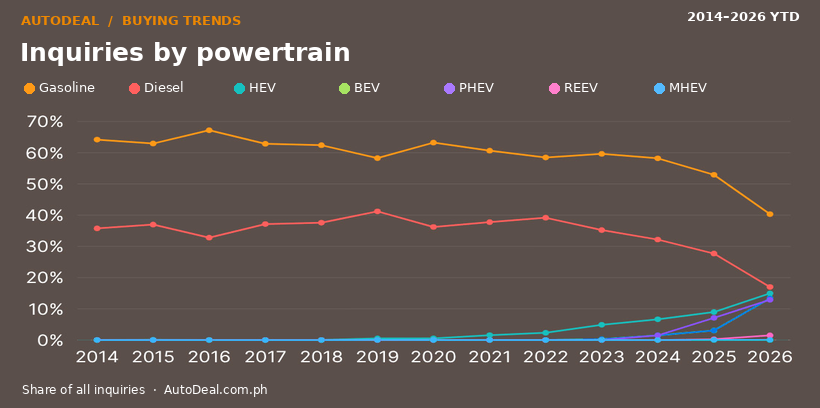
For most of the past decade, gasoline and diesel dominated inquiries on AutoDeal, together accounting for roughly nine in ten as recently as 2024. In 2026 to date, their combined share is closer to six in ten, while conventional hybrids attract about 15% of inquiries and plug-in hybrids and battery-electric vehicles each account for around 13%.
That broader interest is also evident in purchases, with gasoline-only vehicles falling from approximately 53% of recorded sales in 2024 to 39% this year. Plug-in hybrids (PHEVs) made the largest gain, rising from about 2% to 18% over the same period.
Conventional hybrids (HEVs) account for a further 13%, battery-electric vehicles (BEVs) for 8%, and range-extended electric vehicles (REEVs) for 3%. Together, these four electrified categories represent just over four in ten recorded sales, slightly ahead of gasoline-only models.
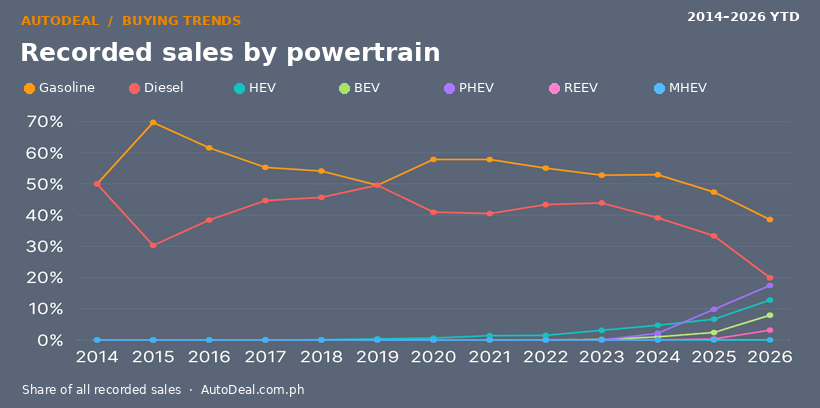
Although higher fuel prices may have accelerated demand in 2026, buyers were already exploring these alternatives. Plug-in hybrids accounted for one in ten recorded purchases in 2025, suggesting that their appeal was growing before this year’s increase in fuel costs.
Chinese brands are reaching the mainstream shortlist
Electrification has given Chinese manufacturers an opening, as families that once compared two gasoline models from familiar brands can now add a Chinese plug-in hybrid to the shortlist. That introduces questions the family may never have asked on its last car purchase, such as how much of the daily commute could the car cover on battery power? Is there somewhere to charge at home? Would the fuel savings justify a difference in the monthly payment?
The scale of China’s home market helps explain the range of vehicles its manufacturers can offer with more than 13 million electric cars sold in China in 2025, accounting for around 60% of global electric car sales. Plug-in hybrids and battery-electric vehicles together represented nearly 55% of all new cars sold in China that year. www.iea.org
The Philippines ranked ninth among destinations for light vehicles exported from China in 2025 and was the only Southeast Asian country in the top ten. That ranking covers vehicles built in China across all brands. What interests me at AutoDeal is what happens closer to the point of purchase, when a Filipino shopper asks a dealer for a quote on a Chinese vehicle.
How buyers plan to pay
When someone inquires about a vehicle on AutoDeal, the platform asks how they intend to pay. In August 2026, 65.84% of shoppers considering Chinese brands said they needed an auto loan or dealer financing. Among shoppers considering other brands, the figure was 65.09%. Whichever badge was on the car, roughly two in three prospects needed financing.
In September, the gap widened, with the share seeking financing for a Chinese brand rising to 66.71%, up 0.87 percentage points from August and for other brands, it fell to 60.58%, down 4.51 points. Across all nine months, the more consistent finding was that a majority of prospects in both groups wanted financing every month.
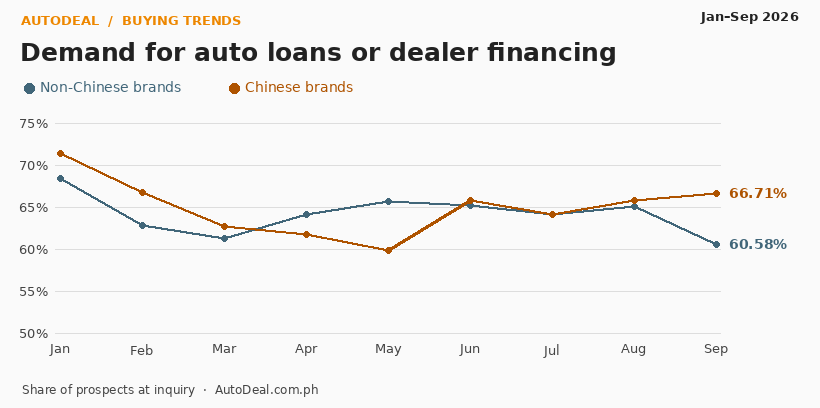
What stands out to me about August is how similar the two groups were. One possible explanation is that Chinese hybrids and EVs are reaching more of the mass market, and as these vehicles make their way onto more families’ shortlists, Chinese brands may increasingly be competing for the same buyers who would have financed a car from an established manufacturer. The brand comparison covers all powertrains, so it cannot isolate how much of that pattern comes from EV shoppers specifically.
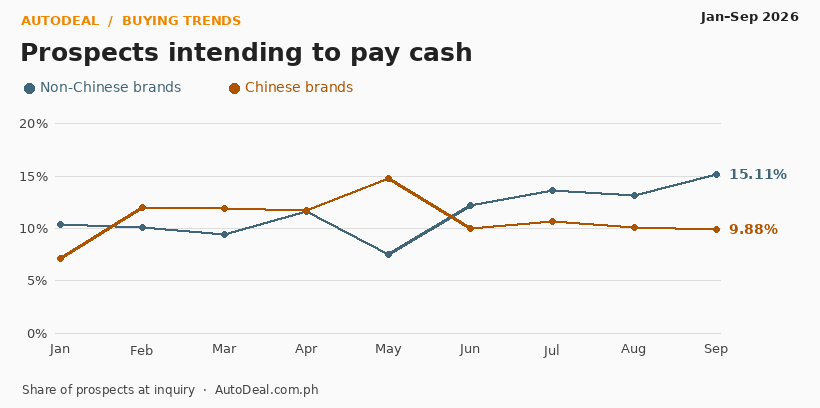
Cash preferences also shifted in May, with 14.77% of Chinese-brand prospects identifying themselves as cash buyers, compared with 7.57% for other brands. From June through September, the pattern reversed and by September, 9.88% of Chinese-brand prospects intended to pay cash, compared with 15.11% for other brands.
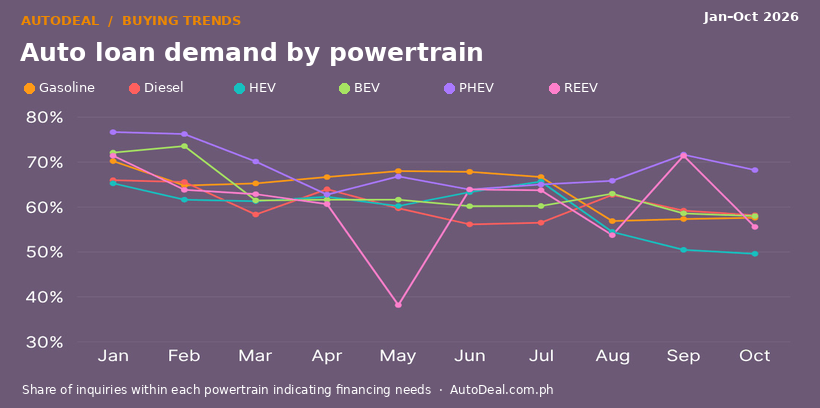
Looking at powertrains separately gives dealers a more specific insight. In October, around 68% of shoppers inquiring about a plug-in hybrid said they needed financing. The figure was roughly 58% for gasoline, diesel and battery-electric vehicles, and around half for conventional hybrids. For a dealer selling plug-in hybrids, a workable finance quote matters in about two out of every three inquiries.
The household budget and the bank’s loan book
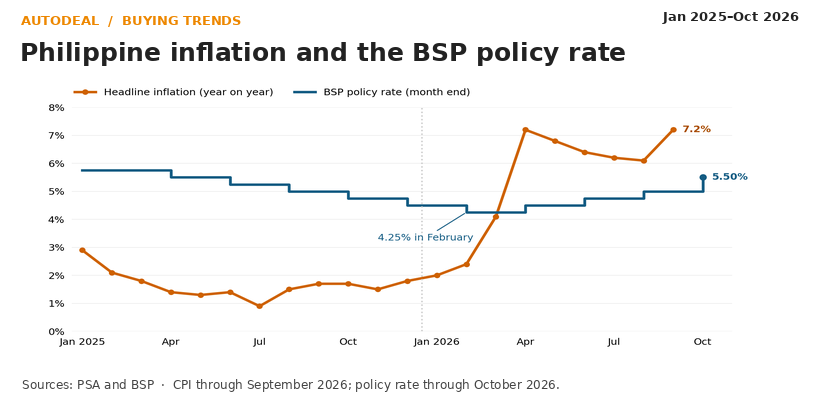
These financing conversations are taking place against a tighter household budget. Philippine headline inflation reached 7.2% in September 2026, compared with 1.7% a year earlier. Food prices rose 6.8% year on year and transport prices rose 14.6%. For a family considering a car, groceries and getting around were already costing more before the first instalment came due. psa.gov.ph
Borrowing conditions also changed during the year, with the Bangko Sentral ng Pilipinas (BSP) cutting its policy rate to 4.25% in February before raising it to 5.00% by September and 5.50% in October. These changes influence banks’ funding costs, although the rate offered on an individual car loan depends on the lender and the loan terms. The October increase adds context to the financing environment but came after buyers had declared the September financing preferences shown in AutoDeal’s data.
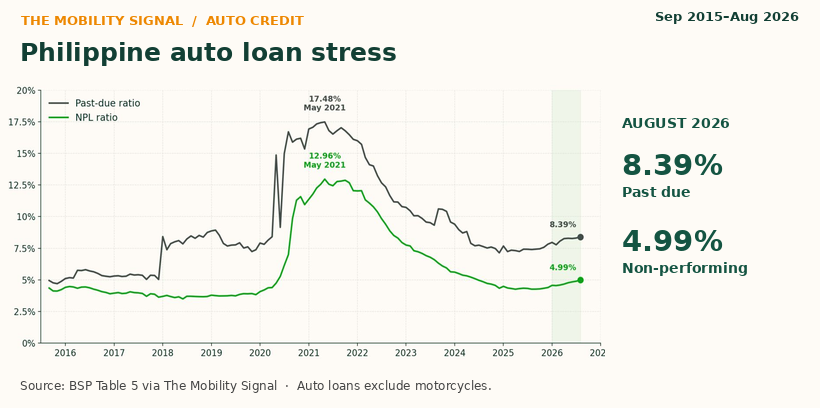
According to BSP data compiled by The Mobility Signal, repayment difficulties were increasing even as banks’ auto loan portfolios remained broadly flat. Outstanding auto loans totalled ₱659.10 billion in August 2026, just 0.36% more than in January, while non-performing balances rose 9.74% to ₱32.90 billion over the same period. Since outstanding balances reflect both new lending and repayments, the modest growth does not necessarily mean banks had stopped issuing loans; it shows that repayment problems were growing faster than the overall loan book.
By August, roughly ₱5 of every ₱100 outstanding was classified as non-performing, while the past-due share stood at 8.39%. Both ratios had risen by 0.43 percentage points since January, indicating mounting pressure on borrowers, although they remained well below their May 2021 peaks.
For a family considering a plug-in hybrid, the dealer’s quote brings the prospect of lower running costs into focus alongside the immediate cost of ownership: finding the cash for a down payment and fitting the monthly loan repayments into the household budget. The lender, meanwhile, must assess whether that family can sustain those payments over several years.
Few shoppers arrive with financing already in place
Among prospects considering Chinese brands, the share reporting an existing bank pre-approval rose from 3.19% in February to 7.88% in May, before falling to 3.35% in September. For other brands, the monthly share stayed within a narrower range of 3.32% to 4.55%.
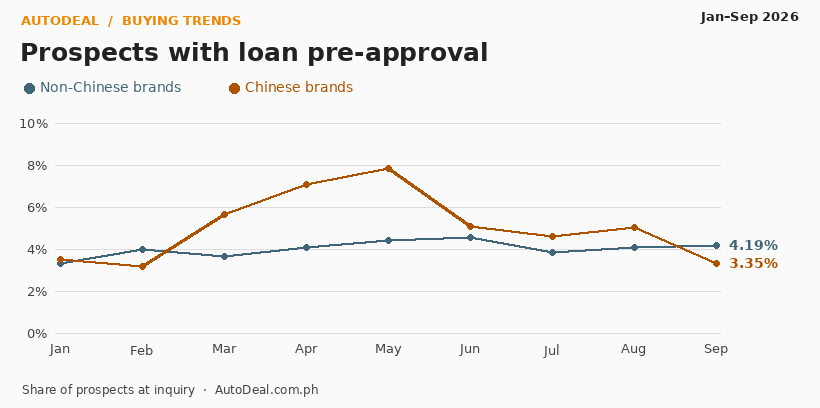
Dealers I spoke with associated the rise in pre-approvals around May with heightened interest in hybrids and EVs as fuel costs became a concern. One possible explanation for the subsequent decline is that some shoppers waited to arrange financing through the dealership after choosing a vehicle. AutoDeal captures what customers declare when they inquire, helping to establish which financing route they eventually took.
With around two-thirds of Chinese-brand prospects indicating a need for financing in September, but only about one in thirty arriving with pre-approval, sales agents have a clear opportunity to help buyers understand what they can afford. A quote that sets out the cash required upfront, the monthly instalment and the loan term gives buyers something concrete to take home and discuss with their families.
What has changed for the Filipino car buyer
Looking back on those conversations ten years ago, I understand why dealer executives placed so much weight on reputation. Reliability, after-sales support and resale value still matter to a family committing to several years of car payments.
What I underestimated was how quickly buyers could broaden their shortlists, continuing to value the reliability, after-sales support and resale confidence associated with Japanese brands while finding that a Chinese plug-in hybrid better suits their driving needs. On AutoDeal, I can see those changing preferences in both the vehicles people inquire about and the purchases they go on to make.
As manufacturers compete for a place on the family’s shortlist, dealers and lenders play an equally important role in helping buyers work out whether their preferred car fits the household budget. For many Filipino buyers, choosing a vehicle and deciding how to pay for it go hand in hand, with the specifications and financing quote open on the same kitchen table.
Data coverage. AutoDeal figures describe inquiries and recorded sales on the platform. Powertrain shares are approximate, and 2026 sales and inquiry figures are year to date. Financing preferences by brand cover January–September 2026, while financing preferences by powertrain cover January–October 2026. The Mobility Signal’s credit chart uses BSP Philippine Banking System auto loan data through August 2026 and excludes motorcycle loans. The macroeconomic chart includes inflation through September and the BSP policy rate through October.